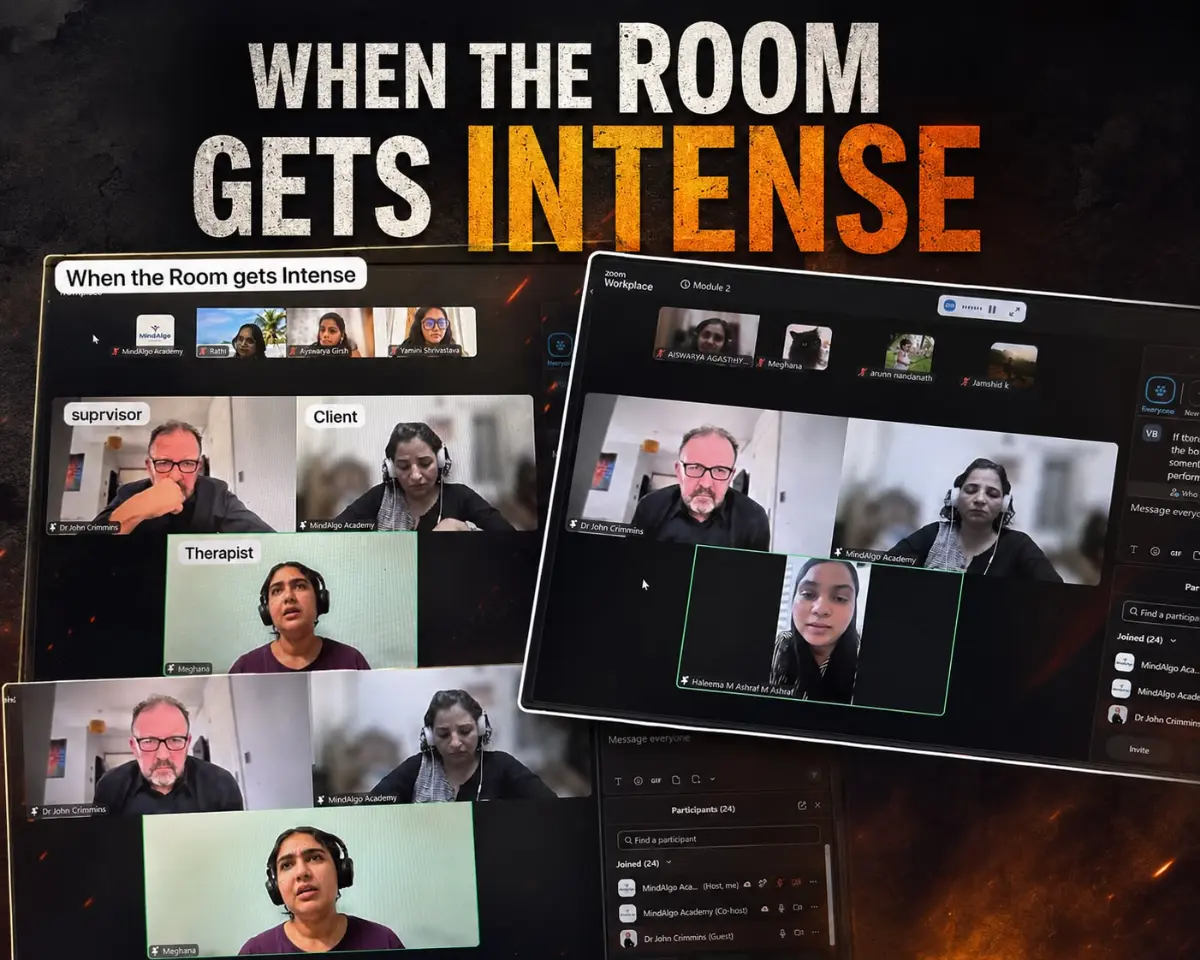

The room was quiet.
A group of psychology trainees sat in a semicircle, notebooks open, each carrying a mixture of excitement and nervous anticipation. They had spent weeks learning about Cognitive Behavioural Therapy (CBT). They could explain the cognitive model, identify automatic thoughts, and even list common cognitive distortions from memory.
Then their trainer smiled and said, "Today, you're the therapist."
Almost instantly, the atmosphere changed. One trainee volunteered reluctantly. Another agreed to play the client a young professional struggling with panic attacks before presentations. The "therapist" took a deep breath and began.
"So... tell me what's been happening."
The conversation stumbled. There were awkward pauses. Questions came too quickly. Opportunities to explore thoughts were missed. The trainee knew the theory but found it surprisingly difficult to apply it in real time. The session ended after ten minutes.
No one criticized the trainee.
Instead, the trainer asked, "What did you notice?"
The room came alive. Someone pointed out how the therapist shifted too quickly into problem-solving. Another noticed that the client's emotions hadn't been explored before challenging their thoughts. A third trainee appreciated the therapist's empathy but suggested using more Socratic questioning. Then something remarkable happened.The same trainee repeated the exercise.This time, the conversation flowed differently.Instead of offering reassurance, the therapist became curious.
"What was going through your mind at that moment?"
"What evidence supports that belief?"
"If your friend were in this situation, what would you tell them?"
The difference was noticeable not because the trainee had memorized more theory in those ten minutes, but because they had experienced learning. This is the true power of role play in CBT training.
Many clinicians remember the first time they conducted a therapy session. It rarely resembles the polished demonstrations shown in textbooks. Therapy unfolds unpredictably. Clients hesitate. They become emotional. They challenge interpretations. Sometimes they simply say, "I don't know." These moments cannot be mastered through reading alone. CBT is often described as structured, but it is also deeply human. Every intervention requires the therapist to balance technique with curiosity, empathy, and collaboration. Knowing what to do is only half the journey. Knowing how and when to do it develops through practice.
Role play creates the bridge between these two worlds. It transforms abstract concepts into lived clinical experiences.
Imagine learning to ride a bicycle by reading a manual. You might understand balance, steering, and braking perfectly. Yet the first time you sit on the bicycle, your body quickly reminds you that knowledge and skill are not the same. Therapy is remarkably similar.
Reading about guided discovery is valuable. Watching an experienced therapist challenge a cognitive distortion is inspiring. But until trainees ask those questions themselves, adjust their responses, recover from mistakes, and receive feedback, the learning remains incomplete. Role play allows therapists to experience these moments before they occur with actual clients.
It is practice without the risk.

One of the most fascinating aspects of role play is that learning happens for everyone not only the person acting as the therapist.
The trainee playing the client often discovers how subtle differences in questioning affect emotional safety. Observers begin noticing therapist habits they had never recognized before: interrupting too early, asking closed-ended questions, offering reassurance instead of facilitating discovery, or missing opportunities to summarize. Every perspective adds another layer of clinical understanding. Learning becomes collaborative rather than individual.
As CBT training advances, role plays become increasingly complex, helping trainees practice real clinical challenges such as perfectionism, obsessive doubts, emotional avoidance, resistance, and difficult therapeutic moments. Through repeated practice and feedback, trainees move beyond simply applying techniques and begin to understand what each client needs, developing genuine clinical thinking, flexibility, and therapeutic connection.
Although role play can feel challenging, these experiences become valuable opportunities for growth. They help future therapists build confidence, empathy, and presence while learning that effective therapy is not only about knowing CBT methods but also about responding thoughtfully to each person. Ultimately, role play prepares therapists for real-world practice by transforming theoretical knowledge into meaningful, collaborative therapeutic skills.
This article is for informational purposes only and does not constitute medical advice, diagnosis, or treatment. Always consult with a qualified healthcare provider for personal medical concerns.
Have questions about this topic? Our team is happy to help. Get in touch →